
FREE DELIVERY ON ORDERS OVER £75
Get this wrong and the pump either won't start or will cavitate itself to death within months. Choosing between a positive head vs negative head pump is one of the most common decisions on any gravity-fed hot water system — and one of the most commonly bodged. This guide cuts straight to what matters: how to read the system, pick the right pump, and fit it correctly first time.
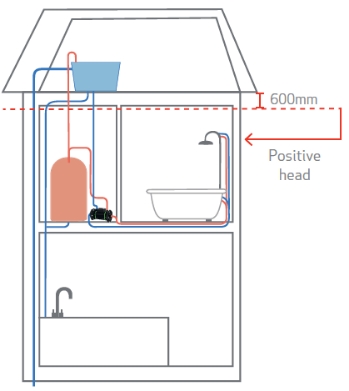
Before you touch a pump, you need to confirm the system type. Positive and negative head pumps only apply to gravity-fed (vented) systems — the ones with a cold-water storage tank in the loft and a hot-water cylinder in the airing cupboard. Combi boilers and unvented (sealed) cylinders operate at mains pressure and do not use shower pumps at all.
On a gravity-fed system, pressure is determined by the height of water above the outlet. That height — the static head — dictates everything. The pump sits in the hot and cold feeds to the shower, gives both a boost, and lets gravity pull water through. Simple in principle, less simple in practice because the position of the pump relative to the outlet and the cold-water tank determines which pump type you need.
This is the bit that trips people up.
A positive head pump is triggered by flow. When the shower valve is opened, water flows naturally through the pump — gravity pushes at least 1–2 litres per minute through it — and that flow activates an internal flow switch, starting the pump. For this to work, the pump must be positioned so that gravity will always prime it: typically on the ground floor or in the airing cupboard, with the cold-water tank at least 600mm above the pump body.
A negative head (universal) pump works differently. It can't rely on gravity flow to trigger it because the installation has little or none. Instead, it pressurises the pipework between itself and the outlet. When the shower valve opens, that pressure drop is sensed, and the pump starts. These pumps work in both positive and negative head conditions — which is why they're often called "universal."
When do you have a negative head situation?
In these situations, a positive head pump will hunt, prime fail, or simply never switch on. You need a universal (negative head) model.
The fastest way: isolate the supply, hold a 15mm pipe up to the cold-water inlet where the pump will connect, and time the flow into a jug. If you're getting 2+ litres per minute naturally, you're in positive head territory. If it's sluggish — under a litre per minute or just dribbling — assume negative head and spec a universal pump accordingly.
A second check: is there at least 600mm of vertical distance between the bottom of the cold-water tank and the pump inlet? If yes, a positive head pump should trigger reliably. If no, go universal.
Don't guess. A misspecified pump returned two weeks post-fit is a warranty headache nobody needs.
Once you've settled the head question, you need to decide between single and twin impeller.
Single impeller pumps boost one supply — either hot or cold, not both. Used where only one side needs pressure (uncommon in shower pump applications).
Twin impeller pumps boost both hot and cold simultaneously, keeping balanced pressure across the shower valve. This is what virtually every shower pump job calls for. Mismatched pressure at the valve means temperature instability and thermostatic valves hunting — a sign-off problem every time.
Pump output is measured in bar. For a single shower with a standard thermostatic bar valve, 1.5–2.0 bar is usually adequate. For power showers, rain heads, or multi-outlet applications, 3.0 bar is the right call. Go too high and you'll over-pressurise weak fittings; go too low and the customer notices immediately.
Check the shower valve manufacturer's maximum inlet pressure rating before specifying. Most thermostatic bar valves are rated to 3 bar, but some older or budget valves are rated lower.
Both Stuart Turner and Salamander are the benchmark brands — both made in the UK, both with solid warranty coverage, and both regularly available for same-day collection from our Acton branch.
For negative head, positive head, or universal head pump jobs, ask APM for help confirming the right shower pump before fitting. You can also browse APM mains boosting pumps for live stocked pump options.
For installations where 2.0 bar is sufficient and you want a compact footprint, the Stuart Turner Showermate 2.0 Bar Single is a reliable option for single shower applications in positive head systems. Smaller pump body, easier to tuck into an airing cupboard.

Browse the full range on our Mains Boosting Pumps collection.
Fitting a positive head pump on a negative head system. The pump won't trigger. Customer calls you back saying "the pump doesn't work." Always check head conditions before ordering.
Fitting a pump with no flow restriction downstream. Some very open shower valves on a high-bar pump can exceed the valve's rated inlet pressure. Add a pressure-reducing valve if needed.
Ignoring the airing cupboard acoustics. A pump that's mechanically fine but vibrating against a hot-water cylinder or timber shelf sounds terrible. Use anti-vibration feet and ensure the pump is on a firm, stable surface.
We hold Stuart Turner and Salamander shower pumps in stock at 24 Western Avenue, Acton, London W3 7TZ. If you know the spec, call ahead on 020 8702 8080 and we'll have it waiting on the counter. Trade accounts welcome.
Still unsure which pump fits your job? Call us — we'll ask the right questions and get you the right pump, not the nearest one on the shelf.
{"one"=>"Select 2 or 3 items to compare", "other"=>"{{ count }} of 3 items selected"}
Leave a comment