
Free delivery from £50 on eligible UK orders
Free delivery from £50 on eligible UK orders · Collect from Acton · Trade & retail welcome

Every appliance, every tap, every toilet needs a way to isolate it without draining the whole system. Get the valve selection wrong and you’re either under-specced for the application or over-engineering a simple under-sink connection. This guide covers isolating valves, service valves, gate valves, washing machine valves, and check valves — what each is for and when to use it.
The Water Regulations (SI 1999/1148) require that every water fitting can be isolated and drained without needing to shut off the whole supply. In practice this means every appliance — washing machine, dishwasher, WC cistern, basin, bath — needs its own dedicated isolation point. Most local water suppliers will ask about isolation provision on notifiable plumbing work. Beyond compliance, it’s just good practice: you want to be able to change a tap washer or a toilet fill valve without turning the street stop off.
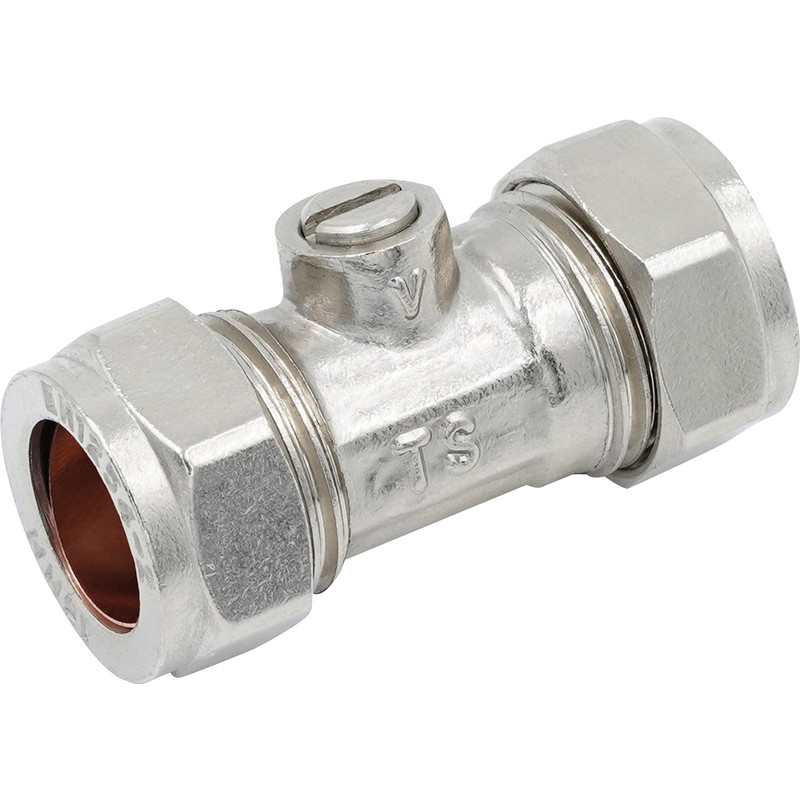
The mini isolating valve is the most common isolation fitting in domestic plumbing. It sits in-line on a 15mm copper or plastic pipe run and uses a flat-bladed screwdriver slot to operate a quarter-turn ball. In-line (open) is when the slot is parallel to the pipe. Turn 90° and it’s closed.
They come in two body patterns:
The Embrass Peerless 15mm Chrome Isolating Valve and the Embrass Peerless 15mm Angle Isolation Valve Chrome cover the two standard configurations. Both are compression x BSP male, the standard connection for tap tail and flexi hose work.
The chrome finish is used on exposed connections under open-plan vanity units or where the valve is visible. For concealed pipe runs (inside cabinets, behind panels), plain brass is fine.
A service valve is effectively a mini isolating valve with a proper lever handle rather than a screwdriver slot. The advantage: it’s quicker to operate and the open/closed position is visually obvious (lever parallel to pipe = open; lever across pipe = closed). Use them anywhere the valve will be operated frequently or where a screwdriver slot would be awkward.
Service valves are also the preferred fitting for WC cistern isolation — the Water Regulations require that cistern supplies can be isolated easily, and a lever valve is more accessible than a screwdriver slot if a non-trade person needs to operate it.
APM stocks the Embrass Peerless service valve range:
Both are 15mm compression x 1/2" BSP male — the standard for connecting flexi hoses to tap tails and WC fill valves.
The Embrass Peerless 15mm Chrome Lever Isolating Valve is a full-bore quarter-turn valve — when open, the ball has the same internal diameter as the pipe, so there’s no restriction to flow. Use these where maintaining full flow rate matters: on boiler feed and return isolation, on filling loop connections, and on supply lines to combination boilers where pressure drop through the valve would affect performance.
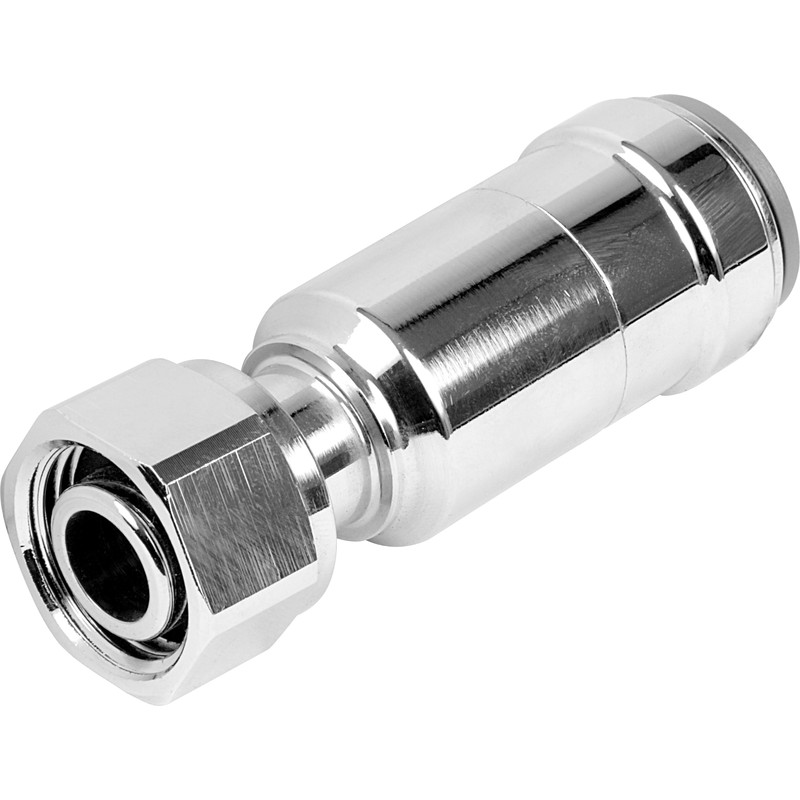
Washing machines and dishwashers require a dedicated isolation valve that terminates in a 3/4" BSP male thread — the standard for washing machine hose connections. Three configurations cover most installations:
Straight valve — the Embrass Peerless 15mm x 3/4" Straight Washing Machine Valve is for horizontal pipe runs behind the machine. The lever or screwdriver-operated ball gives quarter-turn isolation; the 3/4" BSP male end takes the standard washing machine fill hose directly.
Angle valve — the Embrass Peerless 15mm x 3/4" Angled Washing Machine Valve is for rising pipe configurations where the supply comes up through the floor or kickboard behind the machine.
Self-cutting valve — the Embrass Peerless 15mm Self-Cutting Washing Machine Valve clamps onto an existing 15mm pipe and cuts its own entry hole when tightened. No soldering, no compression fitting, no pipe cutting. Used for retrofit installations where the pipe is inaccessible or where cutting the pipe in would require significant disruption. Not a permanent preferred solution — but for a rental refurb or emergency install, it’s the fast option.
Gate valves are the traditional isolation valve for gravity-fed heating and cold water circuits — the large red or blue handled valves typically found on the flow and return connections of hot water cylinders and gravity-fed cold water tanks. They’re not quarter-turn; they operate by screwing a gate up and down across the flow path. Advantages: they’re full-bore when open (no flow restriction) and the gradual operation suits gravity systems where sudden pressure changes can cause water hammer.
Disadvantages: they’re not for mains-pressure applications (the gate can be pushed off its seat under mains pressure), and they’re slow to operate in an emergency. On mains-pressure systems, use a ball valve or lever isolating valve instead.
APM stocks WRAS-approved Embrass Peerless brass gate valves to BS5154 in 15mm, 22mm, and 28mm for cylinder and storage tank connections.
A check valve (non-return valve) allows flow in one direction only. It’s a passive device — water pressure opens the valve; the spring or weight closes it when flow stops or reverses. They’re installed wherever backflow could contaminate the supply or damage equipment.
The Water Regulations identify five fluid categories of contamination risk (1–5). The appropriate check valve depends on the risk category:
Remember: a filling loop without a double check valve on the cold mains connection is a Water Regulations failure. It’s a direct connection between the heating system (fluid category 3) and the potable supply. No exceptions.
APM Electricals stocks the full Embrass Peerless isolating and service valve range and the complete check valve range from the trade counter at 24 Western Avenue, Acton W3 7TZ. Call ahead on 020 8702 8080. Same-day collection, Monday to Friday, no minimum order.
{"one"=>"Select 2 or 3 items to compare", "other"=>"{{ count }} of 3 items selected"}
Leave a comment